
Close print
2026-10-06
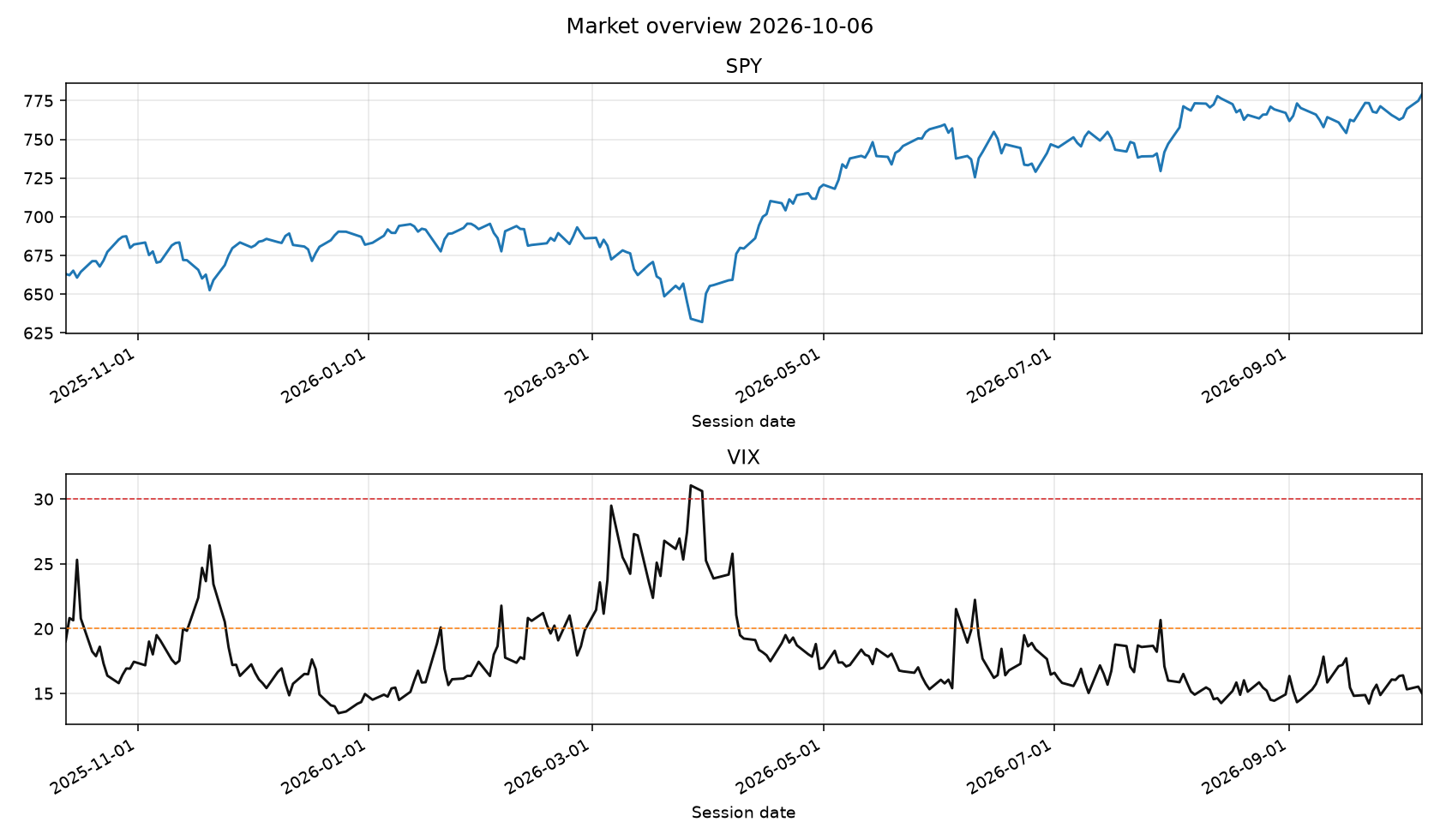
- VIX 15.01 low
- SPY 779.09
- 5 named setups
- Free teaser
Over the measured window — ten years of the local tape, 21 names, onsets spaced so one market phase counts once, and a 10 bps round trip — no named setup beat holding these companies. The unconditional 21-session up-rate was 58.67%. On buy-now versus wait through the next 21 sessions, every setup landed between −0.67% and +0.64% against a random session. One setup clears the publish gate: historic_drawdown at a 61.25% net hit rate on 352 onsets, and its 95% interval bottoms out at 50.33% — a third of a point above a coin. Read that as a gate it passed, not an edge it demonstrated. The desk publishes named setups as context — what happened on the tape — not as timing calls. Scheduled accumulation is the default the evidence supports. The 58.67% figure is not an expected future return: the universe is today's survivors chosen after the fact, which inflates the absolute up-rate.
Desk take
What we think of this print
Close print for 2026-10-06. VIX 15.01 (low) and SPY 779.09 set the tape. Hybrid desk: the scanner names the setup, the model grades that same print, and published conviction is the blend. The model cannot add a name that did not fire.
NVIDIA Corporation (NVDA): scanner what happened — NVDA traded cheaper than its industry peers on trailing P/E at 100/100 (setup 100). Why it printed: Trailing P/E 34.1 is below the semiconductors peer median 46.2 (26% cheaper).; Market cap still sits above the peer median ($5.78T vs $1.06T).; Cap is more than 2× the peer median — quality/size filter.; VIX regime is low (15.01).; 21d relative strength vs SPY is 2.7%.; Relative volume 0.93x.. Invalidation: Multiple re-rates up to the peer median P/E, or a daily close back below SMA200; stop ~227.59.. Continuation of the 2026-10-05 alert, not a new one — this is print 3 of one run: the same call has gone out twice since 2026-10-02 across 4 calendar days, most recently on 2026-10-05. Today is not a fresh signal; the setup was already true when the desk last printed it. The analog below measures the first session of a run, so its hit rate belongs to 2026-10-02, not to today. Same-setup analogs on 21 names (n=265, n_eff=84.8, 95% CI 48–68%) show a 58% 21-session net hit rate against a 59% base rate, average +3.0%, vs SPY +1.3%. The 95% interval includes 50%, so this is the desk's narrative setup rather than a demonstrated edge. LLM haircut at 94/100: RSI is firm, not a reset — haircut versus the scanner grade. Risk: Multiple re-rates up to the peer median P/E, or a daily close back below SMA200; stop ~227.59..
Amazon.com, Inc. (AMZN): scanner what happened — AMZN traded cheaper than its industry peers on trailing P/E at 78/100 (setup 98). Why it printed: Trailing P/E 20.6 is below the internet retail / big-box peer median 28.6 (28% cheaper).; Market cap still sits above the peer median ($2.76T vs $350.4B).; Cap is more than 2× the peer median — quality/size filter.; VIX regime is low (15.01).; Relative volume 0.95x.. Invalidation: Multiple re-rates up to the peer median P/E, or a daily close back below SMA200; stop ~245.20.. Same-setup analogs on 21 names (n=265, n_eff=84.8, 95% CI 48–68%) show a 58% 21-session net hit rate against a 59% base rate, average +3.0%, vs SPY +1.3%. The 95% interval includes 50%, so this is the desk's narrative setup rather than a demonstrated edge. LLM confirm at 78/100: Analogs and RSI both support a reset rather than a chase. Risk: Multiple re-rates up to the peer median P/E, or a daily close back below SMA200; stop ~245.20..
Micron Technology (MU): scanner what happened — MU traded cheaper than its industry peers on trailing P/E at 98/100 (setup 98). Why it printed: Trailing P/E 13.8 is below the semiconductors peer median 74.2 (81% cheaper).; Market cap still sits above the peer median ($1.18T vs $827.4B).; VIX regime is low (15.01).; 21d relative strength vs SPY is 1.7%.; Relative volume 0.86x.. Invalidation: Multiple re-rates up to the peer median P/E, or a daily close back below SMA200; stop ~958.68.. Continuation of the 2026-10-05 alert, not a new one — this is print 3 of one run: the same call has gone out twice since 2026-10-02 across 4 calendar days, most recently on 2026-10-05. Today is not a fresh signal; the setup was already true when the desk last printed it. The analog below measures the first session of a run, so its hit rate belongs to 2026-10-02, not to today. Same-setup analogs on 21 names (n=265, n_eff=84.8, 95% CI 48–68%) show a 58% 21-session net hit rate against a 59% base rate, average +3.0%, vs SPY +1.3%. The 95% interval includes 50%, so this is the desk's narrative setup rather than a demonstrated edge. LLM confirm at 98/100: Analogs and RSI both support a reset rather than a chase. Risk: Multiple re-rates up to the peer median P/E, or a daily close back below SMA200; stop ~958.68..
Meta Platforms, Inc. (META): scanner what happened — META saw its 50-day average cross above the 200-day at 84/100 (setup 95). Why it printed: SMA50 crossed above SMA200 on this session.; Close also above SMA50.; 21d RS vs SPY 18.6%.; VIX regime low.. Invalidation: Death cross or close below SMA200; initial stop ~690.90.. Same-setup analogs on 21 names (n=111, n_eff=49.4, 95% CI 56–81%) show a 70% 21-session net hit rate against a 59% base rate, average +2.6%, vs SPY +0.8%. The 95% interval includes 50%, so this is the desk's narrative setup rather than a demonstrated edge. LLM haircut at 78/100: RSI is firm, not a reset — haircut versus the scanner grade. Risk: Death cross or close below SMA200; initial stop ~690.90..
Intel (INTC): scanner what happened — INTC pulled back to its 20-day average inside an uptrend at 92/100 (setup 90). Why it printed: Price above SMA50 and SMA50 above SMA200 (bullish regime).; VIX regime is low (15.01).; RSI_14=52.0 is a reset, not a chase.; Close is -0.5% from SMA20 (pullback/tag).; 21d relative strength vs SPY is 16.3%.; Relative volume 0.93x.. Invalidation: Stop ~100.49 (2x ATR) or daily close back below SMA50.. Same-setup analogs on 21 names (n=1020, n_eff=113.7, 95% CI 51–68%) show a 60% 21-session net hit rate against a 59% base rate, average +2.7%, vs SPY +1.4%. The 95% interval includes 50%, so this is the desk's narrative setup rather than a demonstrated edge. LLM confirm at 92/100: Analogs and RSI both support a reset rather than a chase. Risk: Stop ~100.49 (2x ATR) or daily close back below SMA50..
Applied Materials (AMAT): scanner what happened — AMAT traded cheaper than its industry peers on trailing P/E at 91/100 (setup 88). Why it printed: Trailing P/E 48.6 is below the semiconductor equipment peer median 57.4 (15% cheaper).; Market cap still sits above the peer median ($420.8B vs $417.8B).; VIX regime is low (15.01).; 21d relative strength vs SPY is 15.5%.. Invalidation: Multiple re-rates up to the peer median P/E, or a daily close back below SMA200; stop ~492.19.. Same-setup analogs on 21 names (n=265, n_eff=84.8, 95% CI 48–68%) show a 58% 21-session net hit rate against a 59% base rate, average +3.0%, vs SPY +1.3%. The 95% interval includes 50%, so this is the desk's narrative setup rather than a demonstrated edge. LLM haircut at 85/100: RSI is firm, not a reset — haircut versus the scanner grade. Risk: Multiple re-rates up to the peer median P/E, or a daily close back below SMA200; stop ~492.19..
Broadcom (AVGO): scanner what happened — AVGO broke out of a Bollinger squeeze at 89/100 (setup 86). Why it printed: Bollinger bandwidth was compressed, then close cleared the upper band.; Relative volume 1.26x on the expansion.; Bullish SMA regime.; VIX regime low.. Invalidation: Back inside the band / stop ~353.28.. Same-setup analogs on 21 names (n=343, n_eff=78.4, 95% CI 46–67%) show a 57% 21-session net hit rate against a 59% base rate, average +2.3%, vs SPY +0.7%. The 95% interval includes 50%, so this is the desk's narrative setup rather than a demonstrated edge. LLM confirm at 89/100: Analogs and RSI both support a reset rather than a chase. Risk: Back inside the band / stop ~353.28..
Apple Inc. (AAPL): scanner what happened — AAPL pulled back to its 20-day average inside an uptrend at 88/100 (setup 85). Why it printed: Price above SMA50 and SMA50 above SMA200 (bullish regime).; VIX regime is low (15.01).; RSI_14=54.6 is a reset, not a chase.; Close is 0.1% from SMA20 (pullback/tag).; 21d relative strength vs SPY is 3.1%.. Invalidation: Stop ~320.36 (2x ATR) or daily close back below SMA50.. Continuation of the 2026-10-05 alert, not a new one — this is print 3 of one run: the same call has gone out twice since 2026-10-02 across 4 calendar days, most recently on 2026-10-05. Today is not a fresh signal; the setup was already true when the desk last printed it. The analog below measures the first session of a run, so its hit rate belongs to 2026-10-02, not to today. Same-setup analogs on 21 names (n=1020, n_eff=113.7, 95% CI 51–68%) show a 60% 21-session net hit rate against a 59% base rate, average +2.7%, vs SPY +1.4%. The 95% interval includes 50%, so this is the desk's narrative setup rather than a demonstrated edge. LLM confirm at 88/100: Analogs and RSI both support a reset rather than a chase. Risk: Stop ~320.36 (2x ATR) or daily close back below SMA50..
Alphabet Inc. (GOOGL): scanner what happened — GOOGL traded cheaper than its industry peers on trailing P/E at 76/100 (setup 85). Why it printed: Trailing P/E 17.5 is below the interactive media peer median 18.2 (4% cheaper).; Market cap still sits above the peer median ($2.04T vs $9.9B).; Cap is more than 2× the peer median — quality/size filter.; VIX regime is low (15.01).; 21d relative strength vs SPY is 1.6%.. Invalidation: Multiple re-rates up to the peer median P/E, or a daily close back below SMA200; stop ~330.77.. Same-setup analogs on 21 names (n=265, n_eff=84.8, 95% CI 48–68%) show a 58% 21-session net hit rate against a 59% base rate, average +3.0%, vs SPY +1.3%. The 95% interval includes 50%, so this is the desk's narrative setup rather than a demonstrated edge. LLM confirm at 76/100: Analogs and RSI both support a reset rather than a chase. Risk: Multiple re-rates up to the peer median P/E, or a daily close back below SMA200; stop ~330.77..
Qualcomm (QCOM): scanner what happened — QCOM pulled back to its 20-day average inside an uptrend at 88/100 (setup 85). Why it printed: Price above SMA50 and SMA50 above SMA200 (bullish regime).; VIX regime is low (15.01).; RSI_14=49.1 is a reset, not a chase.; Close is -2.8% from SMA20 (pullback/tag).; 21d relative strength vs SPY is 6.1%.. Invalidation: Stop ~165.41 (2x ATR) or daily close back below SMA50.. Continuation of the 2026-10-05 alert, not a new one — this is print 3 of one run: the same call has gone out twice since 2026-10-02 across 4 calendar days, most recently on 2026-10-05. Today is not a fresh signal; the setup was already true when the desk last printed it. The analog below measures the first session of a run, so its hit rate belongs to 2026-10-02, not to today. Same-setup analogs on 21 names (n=1020, n_eff=113.7, 95% CI 51–68%) show a 60% 21-session net hit rate against a 59% base rate, average +2.7%, vs SPY +1.4%. The 95% interval includes 50%, so this is the desk's narrative setup rather than a demonstrated edge. LLM confirm at 88/100: Analogs and RSI both support a reset rather than a chase. Risk: Stop ~165.41 (2x ATR) or daily close back below SMA50..
KLA (KLAC): scanner what happened — KLAC pulled back to its 20-day average inside an uptrend at 81/100 (setup 75). Why it printed: Price above SMA50 and SMA50 above SMA200 (bullish regime).; VIX regime is low (15.01).; RSI_14=56.7 is a reset, not a chase.; 21d relative strength vs SPY is 5.2%.; Relative volume 1.05x.. Invalidation: Stop ~181.77 (2x ATR) or daily close back below SMA50.. Same-setup analogs on 21 names (n=1020, n_eff=113.7, 95% CI 51–68%) show a 60% 21-session net hit rate against a 59% base rate, average +2.7%, vs SPY +1.4%. The 95% interval includes 50%, so this is the desk's narrative setup rather than a demonstrated edge. LLM confirm at 81/100: Analogs and RSI both support a reset rather than a chase. Risk: Stop ~181.77 (2x ATR) or daily close back below SMA50..
Marvell Technology (MRVL): scanner what happened — MRVL broke out on expanded volume at 79/100 (setup 72). Why it printed: Close cleared the 20-session high.; Breakout volume 2.72x average.; Bullish SMA regime.; VIX regime low.. Invalidation: Failed break if close back under 280.00; stop ~258.17.. Same-setup analogs on 21 names (n=535, n_eff=90.2, 95% CI 47–67%) show a 58% 21-session net hit rate against a 59% base rate, average +2.7%, vs SPY +1.7%. The 95% interval includes 50%, so this is the desk's narrative setup rather than a demonstrated edge. LLM haircut at 73/100: RSI is firm, not a reset — haircut versus the scanner grade. Risk: Failed break if close back under 280.00; stop ~258.17..
Advanced Micro Devices (AMD): scanner what happened — AMD closed near a 52-week high at 74/100 (setup 65). Why it printed: Within 1.4% of 52-week high.; Still in a bullish SMA regime.; Beating SPY by 34.8% over 21d.; VIX regime low.. Invalidation: Failed breakout if close back below prior 52w high and stop ~601.47.. Same-setup analogs on 21 names (n=741, n_eff=102.0, 95% CI 49–68%) show a 59% 21-session net hit rate against a 59% base rate, average +2.8%, vs SPY +1.8%. The 95% interval includes 50%, so this is the desk's narrative setup rather than a demonstrated edge. LLM wait at 62/100: RSI is stretched; the setup fired but this still looks like a chase. Risk: Failed breakout if close back below prior 52w high and stop ~601.47..
Taiwan Semiconductor (TSM): scanner what happened — TSM closed near a 52-week high at 74/100 (setup 65). Why it printed: Within 1.1% of 52-week high.; Still in a bullish SMA regime.; Beating SPY by 11.3% over 21d.; VIX regime low.. Invalidation: Failed breakout if close back below prior 52w high and stop ~461.41.. Same-setup analogs on 21 names (n=741, n_eff=102.0, 95% CI 49–68%) show a 59% 21-session net hit rate against a 59% base rate, average +2.8%, vs SPY +1.8%. The 95% interval includes 50%, so this is the desk's narrative setup rather than a demonstrated edge. LLM wait at 62/100: RSI is stretched; the setup fired but this still looks like a chase. Risk: Failed breakout if close back below prior 52w high and stop ~461.41..
Microsoft Corporation (MSFT): scanner what happened — MSFT pulled back to its 20-day average inside an uptrend at 70/100 (setup 60). Why it printed: Price above SMA50 and SMA50 above SMA200 (bullish regime).; VIX regime is low (15.01).; 21d relative strength vs SPY is 4.8%.; Relative volume 0.97x.. Invalidation: Stop ~505.85 (2x ATR) or daily close back below SMA50.. Continuation of the 2026-09-11 alert, not a new one — this is print 2 of one run: the same call went out on 2026-09-11. Today is not a fresh signal; the setup was already true when the desk last printed it. The analog below measures the first session of a run, so its hit rate belongs to 2026-09-11, not to today. Same-setup analogs on 21 names (n=1020, n_eff=113.7, 95% CI 51–68%) show a 60% 21-session net hit rate against a 59% base rate, average +2.7%, vs SPY +1.4%. The 95% interval includes 50%, so this is the desk's narrative setup rather than a demonstrated edge. LLM haircut at 64/100: RSI is firm, not a reset — haircut versus the scanner grade. Risk: Stop ~505.85 (2x ATR) or daily close back below SMA50..
ASML Holding (ASML): scanner what happened — ASML pulled back to its 20-day average inside an uptrend at 70/100 (setup 60). Why it printed: Price above SMA50 and SMA50 above SMA200 (bullish regime).; VIX regime is low (15.01).; 21d relative strength vs SPY is 5.8%.; Relative volume 1.18x.. Invalidation: Stop ~1735.16 (2x ATR) or daily close back below SMA50.. Same-setup analogs on 21 names (n=1020, n_eff=113.7, 95% CI 51–68%) show a 60% 21-session net hit rate against a 59% base rate, average +2.7%, vs SPY +1.4%. The 95% interval includes 50%, so this is the desk's narrative setup rather than a demonstrated edge. LLM confirm at 70/100: Analogs and RSI both support a reset rather than a chase. Risk: Stop ~1735.16 (2x ATR) or daily close back below SMA50..
Lam Research (LRCX): scanner what happened — LRCX pulled back to its 20-day average inside an uptrend at 70/100 (setup 60). Why it printed: Price above SMA50 and SMA50 above SMA200 (bullish regime).; VIX regime is low (15.01).; 21d relative strength vs SPY is 7.4%.; Relative volume 0.82x.. Invalidation: Stop ~306.45 (2x ATR) or daily close back below SMA50.. Same-setup analogs on 21 names (n=1020, n_eff=113.7, 95% CI 51–68%) show a 60% 21-session net hit rate against a 59% base rate, average +2.7%, vs SPY +1.4%. The 95% interval includes 50%, so this is the desk's narrative setup rather than a demonstrated edge. LLM confirm at 70/100: Analogs and RSI both support a reset rather than a chase. Risk: Stop ~306.45 (2x ATR) or daily close back below SMA50..
Overall: mixed hybrid tape. Read each card's scanner grade, LLM stance, and hybrid conviction separately — not as one market call.
RESEARCH ONLY — not advice.
Scanner names what happened on the tape. The model grades that observation. Hybrid conviction is what publishes. The model cannot add a name that did not fire. Research only — not a timing call.
add reminders
Five add reminders
Live add reminders. Exclusive listing, strongest first. Not a named setup. Does not score. Now vs 52w is close versus the 252-session high. This-name median is that drawdown on this ticker's prior fires of the same gate.
Quiet today: K1 Weekly RSI (fear) · K2 Weekly RSI (elevated) · K3 Daily RSI (fear) · K4 Daily RSI (elevated) · K5 Daily RSI (calm) · K6 Weekly RSI (industry stress) · K7 Weekly RSI (industry elevated) · K8 Daily RSI (industry stress) · K9 Daily RSI (industry elevated) · K10 Daily RSI (industry calm) · K11 Weekly RSI · K12 Daily RSI.
Quiet watch: no desk name is approaching. VIX must already be 30.
MU MU traded cheaper than its industry peers on trailing P/E
Hybrid 98/100 · buy · named setup cheap vs industry
Scanner 98/100 LLM confirm 98/100
Analogs and RSI both support a reset rather than a chase.
Multiple re-rates up to the peer median P/E, or a daily close back below SMA200; stop ~958.68.
- Close
- 1,045.56
- vs SMA20
- +1.5%
- RSI 14
- 53.9
- Stop
- 958.68
Pattern readings
| Pattern | Current | Threshold | vs | Status |
|---|---|---|---|---|
| Historic drawdown | 13.8% | >= top-3 avg 53.8% | 0.26x | below |
| 20d range high | 1045.56 | > 1108.72 | -5.7% | below |
| 20d range low | 1045.56 | < 902.60 | +15.8% | below |
| Relative volume | 0.86x | >= 1.50x expansion / <= 0.70x dry-up | 0.57x vs expansion | below |
| RSI_14 | 53.9 | oversold < 30 · reset 35-58 · overbought > 70 | mid 30-70 | inside |
| MACD vs signal | 30.145 vs 31.366 | cross up: line > signal after line <= signal | spread -1.221 | below |
| Bollinger squeeze | width 21.932 | <= 20%ile cutoff 21.628 | 1.01x cutoff | below |
| vs SMA20 (pullback tag) | +1.5% | -4.0% to +1.2% | +1.5% | outside |
| vs 52w high (breakout) | -16.7% | >= -3.0% (within 3% of high) | -16.7% | below |
| SMA50 vs SMA200 | 961.81 vs 689.87 | golden: 50 > 200 · death: 50 < 200 | +39.4% | above |
| VIX | 15.01 (low) | elevated >= 20 · stress >= 30 | 15.01 | low |
Similar-setup analog
cheap vs industry onset · 265 samples · last 2300 sessions (publish window). What happened on similar days — not a forecast.
| Horizon | n | Hit rate | Base rate | Avg | vs SPY | Beat SPY |
|---|---|---|---|---|---|---|
| 5d | 265 | 57% | 55% | +0.9% | +0.5% | 56% |
| 10d | 264 | 59% | 56% | +1.9% | +0.9% | 52% |
| 21d | 263 | 58% | 59% | +3.0% | +1.3% | 53% |
| 63d | 260 | 65% | 63% | +9.7% | +5.7% | 58% |
| 126d | 251 | 68% | 68% | +17.7% | +10.4% | 59% |
Hit rate is shown next to the 21-session base rate so the comparison is unavoidable. The ~60% absolute up-rate is not an expected future return: the universe is today's winners chosen after the fact. Beat SPY is how often one trade finished ahead of the index; the SPY columns carry no trading cost because buying the index pays the same round trip.
4 more names behind the desk pass
- NVDA cheap vs industry · 97/100
- INTC pullback in uptrend · 92/100
- AVGO squeeze breakout · 89/100
- AMAT cheap vs industry · 88/100
Print board
Discussion
0 notes on this close. Research talk, not advice.
Sign in to join the thread. Reading is open.
No notes yet. First take on this tape is open.